Wage Protection System UAE

UAE WPS update 2026
Blog

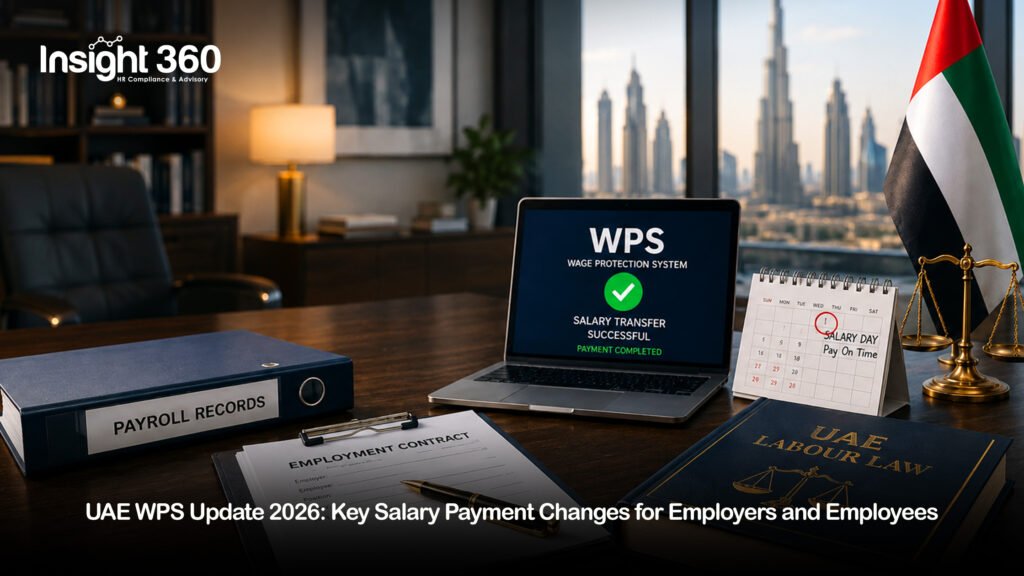
UAE WPS Update 2026: Key Salary Payment Changes for Employers and Employees

Timely salary payments have always been a cornerstone of a healthy employer-employee relationship. In a significant move to strengthen employee protection and enhance payroll compliance, the UAE has introduced updated Wage Protection System (WPS) regulations that came into effect on June 1, 2026. These changes are designed to create greater accountability for employers while ensuring that employees receive their wages on time and in full. As the UAE continues to strengthen its labor market framework, businesses must understand these new requirements and adapt their payroll processes accordingly. For employees, the updates provide greater transparency and assurance regarding salary payments. What’s Changing Under the New WPS Regulations? Under the revised WPS framework, private-sector companies are now required to pay employee salaries on the first day of each Gregorian month for work completed during the previous month. Any salary payment made after the prescribed due date will be classified as delayed under the Wage Protection System. Previously, employers had greater flexibility in determining salary payment schedules, provided they complied with contractual and regulatory requirements. The new regulation establishes a standardized payday across the private sector, creating greater consistency and clarity for both employers and employees. This change ensures that workers know exactly when to expect their salaries and reduces ambiguity regarding payment obligations. Why These Changes Matter The updated WPS regulations are not simply administrative adjustments. They have a direct impact on employee welfare and business accountability. For employees, receiving salaries on time is essential for managing everyday financial responsibilities such as: Salary delays can create unnecessary financial stress and uncertainty, affecting employee morale, productivity, and overall well-being. By introducing stricter payment requirements, the UAE government is reinforcing its commitment to protecting workers and maintaining a fair and transparent employment environment. For employers, the changes serve as a reminder that payroll compliance is not merely an administrative task but a fundamental business responsibility. Stronger Compliance Measures and Enforcement One of the most significant aspects of the 2026 WPS update is the introduction of stronger compliance monitoring and enforcement procedures. Authorities now have enhanced capabilities to track salary payments and identify delays more efficiently. Companies that fail to meet payment deadlines may face escalating consequences depending on the severity and duration of non-compliance. Potential consequences may include: The objective of these measures is not solely to penalize businesses but to encourage a culture of accountability, transparency, and timely payroll management throughout the private sector. Employers are expected to take proactive steps to ensure salary payments are processed accurately and within the required timeframe. What Employers Should Do Now With the updated WPS regulations now in effect, businesses should review their payroll practices and ensure that all systems and processes are fully compliant. Key actions include: Review Payroll Schedules Organizations should assess existing payroll calendars and ensure salary transfers are scheduled before the monthly deadline to avoid delays. Align Payroll Systems with WPS Requirements Employers should verify that payroll software, banking arrangements, and WPS submission procedures are fully aligned with the latest regulations. Strengthen Coordination Between HR and Finance Payroll compliance requires close collaboration between HR, finance, and management teams. Effective communication can help prevent processing delays and administrative errors. Conduct Regular Compliance Reviews Periodic audits and payroll reviews can help identify potential compliance risks before they result in penalties or regulatory action. Maintain Accurate Employee Records Accurate employee information, salary details, and payment records are essential for successful payroll management and WPS compliance. Organizations that invest in robust payroll processes are more likely to maintain compliance, reduce risk, and build stronger employee trust. What Employees Should Know Employees also play an important role in ensuring transparency and accountability. Workers should: The revised regulations provide greater clarity regarding employee rights and salary payment expectations, making it easier for workers to understand and monitor compliance. Employees who experience salary-related issues may seek assistance through the appropriate regulatory channels, ensuring that concerns are addressed in accordance with UAE labor regulations. Benefits of the New WPS Framework The 2026 WPS update offers several advantages for both employers and employees. Benefits for Employees Benefits for Employers Ultimately, the updated framework supports a healthier and more sustainable employment ecosystem across the UAE. Looking Ahead The UAE continues to strengthen its labor ecosystem through progressive policies that balance employee protection with business sustainability. The latest WPS updates represent another important step toward building a more transparent, fair, and efficient employment environment. As regulatory expectations continue to evolve, organizations must prioritize payroll compliance, workforce management, and HR governance to remain competitive and compliant. For employers, the message is clear: payroll compliance is no longer just an administrative function, it is a critical business responsibility that directly impacts workforce trust and regulatory standing. For employees, the changes provide greater confidence that their hard-earned wages will be paid accurately and on time every month. At Insight 360, we help organizations navigate evolving UAE labor regulations through expert HR compliance, payroll advisory, and workforce management services. Our team works closely with businesses to strengthen payroll processes, ensure WPS compliance, conduct HR audits, and implement best practices that support operational efficiency and regulatory compliance. Whether you are a startup, SME, or large enterprise, Insight 360 provides the guidance and expertise needed to build a compliant, productive, and future-ready workforce in the UAE.

employer obligation in uae
Blog

Employer Obligations in the UAE: Building a Compliant and Responsible Workplace 

Running a successful business in the United Arab Emirates (UAE) requires a strategic balance between operational growth and strict adherence to a rapidly evolving regulatory framework. Beyond corporate strategies and revenue generation, employers carry profound responsibilities toward their workforce. The UAE government has established a highly structured framework designed to protect employee rights, promote workplace safety, and foster a fair, balanced, and productive economic environment.  Understanding and fulfilling these employer obligations is no longer just a box-ticking exercise for legal compliance—it is a critical business strategy. Prioritizing legal and ethical responsibilities builds deep corporate trust, mitigates devastating legal and financial disputes, and elevates an organization’s professional reputation in a highly competitive market.  Why Employer Obligations Matter  In the UAE, employment relationships are governed tightly by federal labor regulations, most notably UAE Federal Decree-Law No. 33 of 2021 regarding the Regulation of Employment Relations, along with its subsequent amendments and executive regulations. These laws are intentionally designed to strike a sustainable balance between the operational needs of employers and the fundamental rights of employees.  For businesses operating in mainland UAE and its various free zones, systematically meeting these obligations ensures three key organizational advantages:  Core Employer Responsibilities in the UAE  While specific workplace rules may slightly vary depending on whether a business operates in a specialized free zone (like Dubai Multi Commodities Centre or Abu Dhabi Global Market) or on the mainland, there are several foundational responsibilities every single employer must systematically execute:  1. Issuing a Clear, Registered Employment Contract  Every employment relationship must be formalized through a written, legally compliant employment contract. This document must explicitly outline the job role, specific responsibilities, direct reporting lines, a detailed salary breakdown (basic salary versus allowances), standard working hours, and the exact notice periods for termination. Crucially, all contracts must be registered directly with MOHRE or the relevant free zone authority to carry legal weight, and they must always align with the latest statutory decrees.  2. Strict, Timely Payment of Salaries via WPS  The Wage Protection System (WPS) is an electronic salary transfer system initiated by the Central Bank of the UAE and MOHRE. Employers are legally mandated to pay their employees’ salaries through this system within established deadlines. Delays, underpayments, or a total failure to utilize the WPS can trigger automatic institutional penalties. These can range from heavy financial fines to the immediate suspension of a company’s ability to issue new work permits or visas.  3. Providing a Safe and Healthy Working Environment  Employee safety is a non-negotiable statutory obligation across all sectors. Employers must proactively curate a workplace that minimizes health and safety risks. This includes implementing strict workplace safety protocols, complying with national environmental and industrial safety regulations, and providing comprehensive training for hazardous tasks. For industrial and outdoor sectors, this also includes strict adherence to mandated midday break rules during the intense summer months.  4. Granting and Documenting Statutory Leave Entitlements  The UAE labor framework guarantees workers comprehensive leave entitlements. Employers must accurately track, approve, and compensate these leaves in strict compliance with the law. This includes:  5. Managing Working Hours and Overtime Compliance  Standard working hours in the UAE are generally capped at 8 hours per day or 48 hours per week. During the holy month of Ramadan, these standard working hours are legally reduced for all fasting and non-fasting employees alike. If business demands require employees to work beyond standard limits, employers must strictly calculate and apply overtime compensation rates as mandated by UAE Labor Law.  6. Accurate Calculation and Settlement of End-of-Service Benefits (Gratuity)  When an employment relationship concludes, employers are legally obligated to calculate and distribute end-of-service benefits. For full-time employees who complete one or more years of continuous service, this involves a calculated monetary gratuity based on their final basic salary and length of service. Employers must settle these final dues alongside any accrued, unused annual leave balances within 14 days of the contract termination date.  7. Actively Respecting and Protecting Employee Rights  Creating a compliant workplace requires fostering a culture of mutual respect and dignity. Employers must proactively enforce anti-discrimination laws that forbid workplace bias based on race, color, gender, religion, national origin, or disability. Furthermore, businesses must actively guard workers against workplace bullying, harassment, and psychological abuse, ensuring every individual’s dignity is preserved.  8. Handling Contract Termination Legally and Professionally  The separation process must always be executed through formal, legally recognized channels. Employers must issue written notices in strict accordance with the agreed contractual notice periods. Arbitrary or unjustified dismissals—where an employee is terminated without a valid performance or structural reason—can result in courts ordering the employer to pay significant compensation to the aggrieved employee.  Final Thought Many legal and operational pitfalls faced by businesses do not stem from a malicious intent to break the law, but rather from a fundamental lack of administrative clarity. Rapid updates to UAE labor decrees, fragmented HR processes, and miscalculated final settlements frequently place employers in difficult positions with regulatory bodies.  To bridge this operational gap and build an airtight compliance ecosystem, businesses need expert guidance. Navigating these complex legislative waters requires the backing of an experienced, highly qualified partner. Look no further than Insight 360 HR Compliance and Advisory, recognized widely as the best HR consultants in the UAE. With their unparalleled industry expertise, deep understanding of MOHRE frameworks, and tailored corporate solutions, Insight 360 empowers your business to seamlessly handle employment contracts, optimize WPS processing, manage complex end-of-service benefits, and maintain an ethical, legally compliant workplace that is positioned for long-term commercial success. 

Scroll to Top